
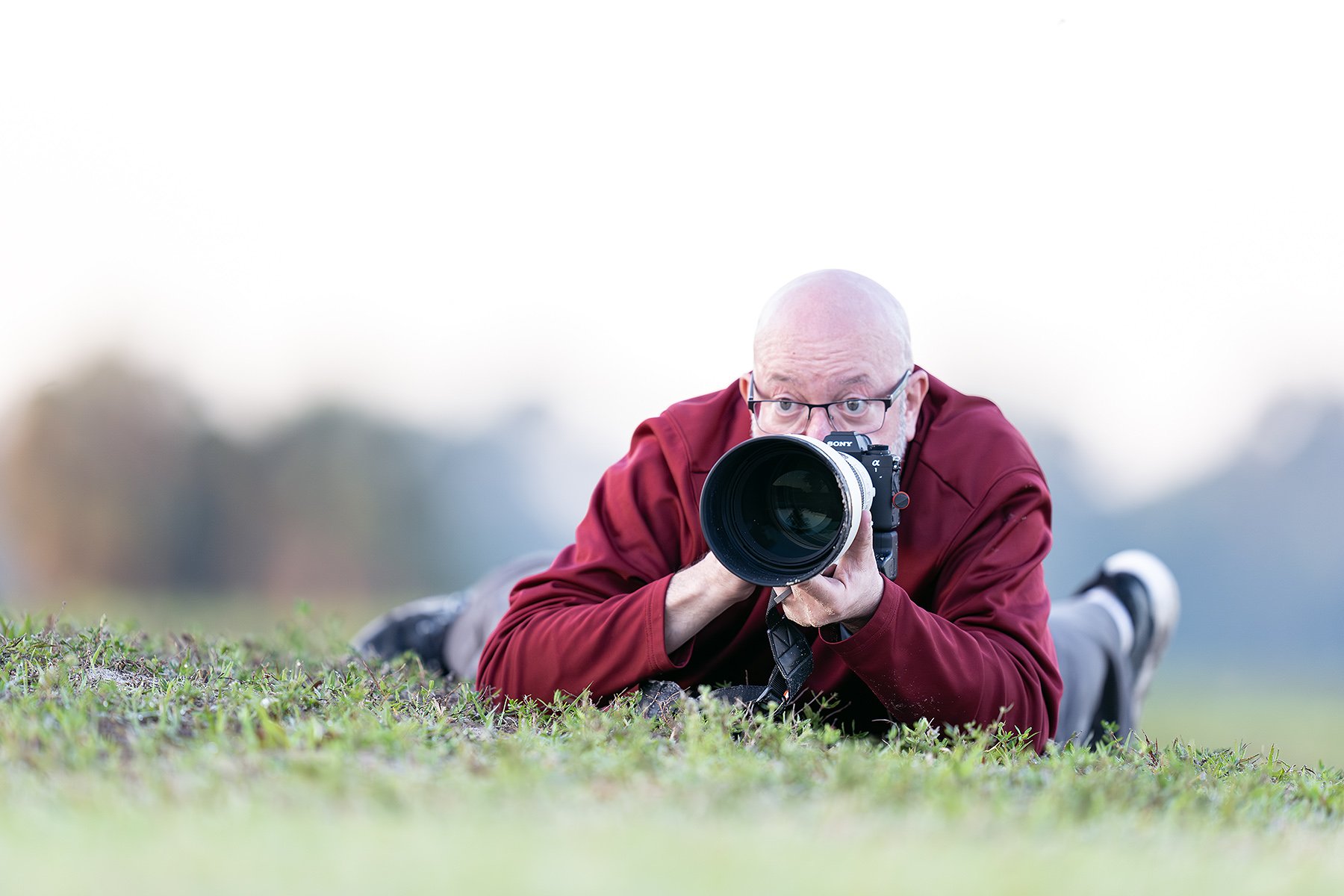
Me photographing sand hill cranes taken by my friend, Arthur Morris
The Journey Begins (April 6, 2026)
Welcome to Steve Shore Photography, and thank you for joining me on this adventure. My love of photography began in 1973, though I didn’t know it at the time. My dad, whose hobby was photography, handed me a Kodak Instamatic with 126 film and those tiny flashbulbs (Google it – they existed at the same time as dinosaurs). He thought I might enjoy taking pictures. Neither of us knew that simple moment would shape the rest of my life. Photography has taken me around the world, introduced me to incredible people – including my wife – and given me a way to tell stories that words alone can’t capture. Sadly, my dad was killed by a drunk driver when I was twenty‑four, and although he never saw how far this passion would take me, he gave me an underlying purpose.
From an early age, I was drawn to science – biology in particular, and I attribute my love of nature and wildlife photography to these roots. I was the kid who watched every Jacques Cousteau and National Geographic television special. When I was six, I watched a show about cryogenics. Being a budding young scientist, I decided to “replicate” the experiment. I remember the show focusing on a laboratory mouse, but I decided a dead beetle from my front yard would suffice. Whereas the real scientists used liquid oxygen, I reasoned that putting a dead bug in a bucket of ice in the family freezer would work. As you can easily imagine, mom screamed when she opened the freezer to get dinner and saw a large dead bug looking at her – and somehow knew I was at fault. I’m not sure she has forgiven me after more than 50 years.
In tenth grade, every student was required to complete twenty‑four hours of volunteer work, but I stayed for three years at Philadelphia’s Academy of Natural Sciences, the nation’s oldest natural history museum. Back then, the museum had a live‑animal unit that cared for injured and rehabilitated wildlife which could not be reintroduced into the wild. Instead, they were well cared for and used in educational programs. I worked with owls (barred, great horned, screech, and barn), hawks (red‑tailed and broad‑winged), skunks, ferrets, opossums, alligators, snakes, and more. Volunteers could also attend guest lectures for free, which is how I found myself at a 1983 book‑tour event for David Attenborough’s Life on Earth series. I was the last person in the room to have my book signed after talking with him about a few episodes, and that book remains one of my most treasured possessions. Years later, after moving to Texas, I met another hero – Jane Goodall. Her autographed books are equally cherished.
As I grew, so did my curiosity. I’ve been fortunate to learn from remarkable photographers who specialize in various genres, but none has shaped me more than my friend Arthur Morris. Before becoming one of the world’s leading bird photographers, Artie spent two decades teaching in the New York school system – he is a phenomenal educator and has forgotten more about photography than most of us will ever learn. There is no doubt in my mind that his guidance has elevated all my work regardless of subject. Mentorship, I’ve learned, is one of the quiet engines that keeps a photographer moving forward.
My first nature and wildlife seminar was around 1980 with John Shaw and Larry West. I didn’t even have a driver’s license yet – my mom drove me to and from Abington, Pennsylvania so I could attend, and I was the youngest person in the room. A couple of years later, my parents and I joined a local camera club in Philadelphia, where monthly seminars and competitions became a foundation for my growth. Those early experiences taught me that photography wasn’t just about equipment; it was about community, curiosity, and showing up.
By my mid‑teens, I was hungry to learn more. At age sixteen, I was allowed to borrow the family car for overnight trips to New Jersey. On one of those trips, I attended a workshop with Leonard Lee Rue, widely considered the grandfather of wildlife photography. I still remember driving home, rehearsing how I would convince my dad to let me spend $1000 to upgrade to a Nikon F3. To his credit, he listened, told me to save my allowance and summer job earnings, and by the end of that summer, I had the new camera in my hands. The lesson I learned here is the value of investing in myself and earning the tools that helped me grow.
Another trip took me to a workshop with Dewitt Jones, who landed his first assignment with National Geographic at just twenty‑one. He and a group of college friends wanted to kayak through China – and somehow convinced the magazine to fund the expedition and supply all the gear and film. Stories like his fueled my imagination and reminded me that photography can open doors you never expected.
Over the years, I’ve learned from many talented photographers – my friends Mike Mezuel and Don Mammoser, Art Wolfe, Frans Lanting, Neil and Susan Silverman, David Muench, and others. Each one added something to my creative and technical toolbox, shaping how I see light, composition, and the world around me. Nature and wildlife photography has taught me three important principles. First is patience, as every nature and wildlife photographer knows mother nature works on her own schedule. Second is adaptability. When photographing outdoors, conditions can change in an instant, so adapting is critical. Third is being observant of your surroundings and living in the moment. I find this one to be especially poignant as I watch people glued to their cell phones while the world happens around them.
Of course, life has its seasons. There were long stretches when work pulled me away from the camera, and I’ve learned I’m cranky when not photographing. One such period was 2012–2013, when my job consumed nearly all my time. My coach and mentor, Lou, saw what I couldn’t. After listening to my excuses, he gave me an ultimatum: take a break and go take pictures, or he would stop mentoring me. He even hung up the phone on me twice and refused to resume our sessions until I sent him a receipt proving I booked a photography trip. His insistence led me to The Texas School of Photography in Addison, where I spent a week studying portrait photography with Kay Eskridge, who sadly passed away in 2024 at age sixty. That experience sparked my interest in photographing people – and in the Dallas area, there are far more people than nature and wildlife, which keeps me shooting. Since then, I’ve studied with portrait and headshot photographers including Peter Hurley, Jerry Ghionis, Gary Hughes, and others. Each new lesson has reminded me that photography is a lifelong craft – one that evolves as we do.
In 2025, my wife and sister – my two biggest supporters – encouraged me to take the leap and start my business, Steve Shore Photography. Photographers love to share their images, and my goal is simple: to share my passion, create inspirational and meaningful work, and help people preserve the moments that matter most. Photography has always been more than a hobby for me – it’s the way I make sense of the world, connect with people, and stay grounded.
And this blog? It’s the next step in that journey. My hope is that these stories spark your curiosity and make you want to follow along as the adventure continues.